
Studies from major clothing resale platforms consistently show that the average person wears 20% of their wardrobe 80% of the time. For remote workers, that skew gets sharper. You kept the blazers from commuting days. You bought the joggers during lockdown. Then came the “WFH casual” pieces, and now you own three separate clothing categories that don’t overlap. The result: a full closet and nothing that actually works well on a Tuesday morning video call.
Sixty days. Ten items. Here is what the experiment actually revealed.
Why Most WFH Wardrobes Are Built Around the Wrong Problem
Office wardrobes have one primary constraint: legibility. You dress to signal competence and belonging to people sharing a physical space with you. Remote wardrobes operate under a completely different constraint structure — one most people don’t stop to map before buying.
WFH dressing has two simultaneous requirements that pull against each other. From the waist up, you need to look intentional on camera. From the waist down, you need to sit comfortably for six to eight hours straight. Most people solve this by separating the two: polished tops for calls, soft pants below the frame. That works, technically. But it produces a wardrobe where half the items only serve half a use case.
Note that results vary significantly based on your specific situation — how often you appear on camera, whether your home office runs warm or cold, and how frequently you leave the house mid-day. A fully remote, all-calls role has different requirements than a hybrid arrangement with three at-home days per week. Keep that individual variation in mind before copying any list wholesale.
The Two Failure Modes to Avoid
Over-casualizing happens when you treat “at home” as an invitation to dress for comfort alone. Wearing gym clothes or sweats all day reliably degrades focus — not because of a productivity myth, but because your brain receives fewer “work mode” environmental signals. Adding shoes and a structured top changes posture and head state measurably.
Over-formalizing is the opposite trap. A dry-clean-only blazer or rigid trousers become physically uncomfortable by early afternoon at a home desk. You abandon them within three weeks. They take closet space and generate guilt without generating outfits.
The Filter That Cuts Through the Noise
Every item in a WFH wardrobe should pass this test: can I wear this for eight hours, step outside for an errand, and still look appropriately put together? Items that fail — too stiff for all-day wear, or too casual for any outside context — are optional at best and a distraction at worst. This filter alone eliminates most impulse buys from standard “WFH wardrobe” recommendation lists before you spend a dollar.
The 10 Items That Held Up After 60 Days
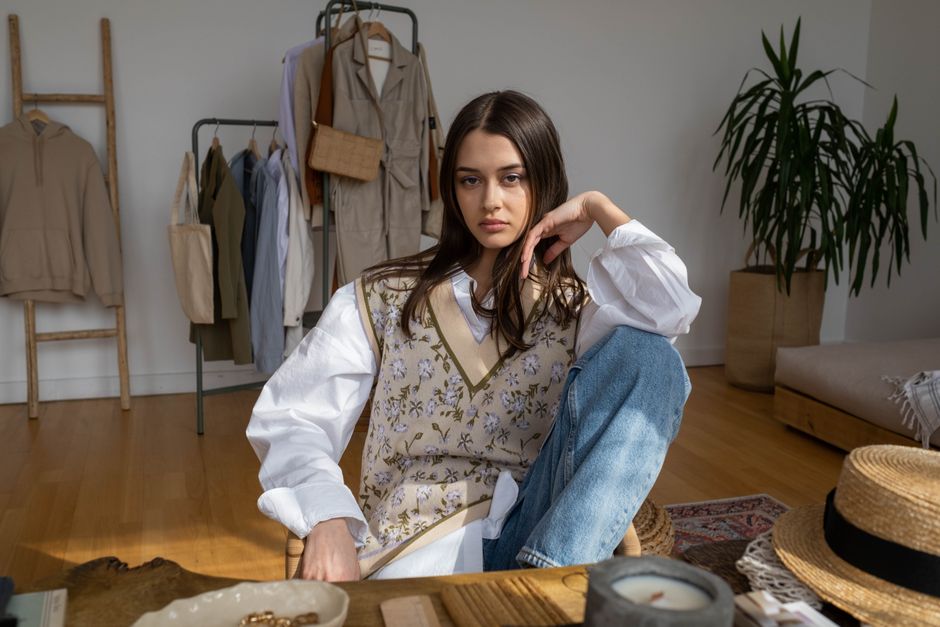
These are the specific items tested. Not aspirational picks. The pieces that actually got worn.
- Two fitted crewneck tees — Uniqlo Supima Cotton T-Shirt ($15 each). One white, one navy. Washed 40-plus times with no pilling or shape loss. Non-negotiable as base layers under everything else.
- One structured stretch blazer — J.Crew Regent Blazer in Stretch Twill ($148). The stretch matters here. A rigid blazer fails in a seated home environment within two weeks of daily use.
- One lightweight cashmere crewneck — Quince Mongolian Cashmere Crewneck ($50). The standout performer of the wardrobe. Full breakdown in Section 4.
- One button-down shirt — Everlane The Clean Silk Simple Shirt ($88). Camera-ready, errand-viable, no ironing required after the first wash.
- Two pairs of stretch trousers — Banana Republic Sloan Slim Pant ($90 each). Mid-rise, no elastic waistband, genuine stretch throughout the leg. One in black, one in camel.
- One pair of dark jeans — Frame Le High Straight ($228). The cut and fabric weight read as put-together on camera in a way that budget denim simply does not.
- One slip-on shoe — Birkenstock Boston Clog ($140). Wearing actual shoes at your desk changes your posture and your mental state. Worth testing before dismissing.
That is eight distinct items. Two slots are held by the pair of Supima tees.
Generic tip #1: Lock in a three-color palette before buying anything — navy, white, and camel work across every item listed here. Without palette discipline, 10 items generates roughly six workable outfits. With it, the same 10 items generate more than twenty distinct combinations.
Generic tip #2: Wash everything before committing to it. Items that shrink, pill, or lose shape in the first wash do not belong in a minimal wardrobe where every piece gets heavy weekly rotation. This test eliminates roughly a third of wardrobe candidates before real money gets spent.
Comfort vs. Camera-Readiness: A Side-by-Side
Not every item performs equally on both dimensions. Here is how the wardrobe scored across 60 days of real use:
| Item | Camera Score (1–5) | All-Day Comfort (1–5) | Practical Verdict |
|---|---|---|---|
| Uniqlo Supima Tee | 3 | 5 | Best base layer; not a standalone call top |
| J.Crew Regent Blazer | 5 | 3 | On for calls, off after; pairs over the tee |
| Quince Cashmere Crewneck | 5 | 5 | The only item with no trade-off required |
| Everlane Silk Shirt | 5 | 4 | Runs warm in offices without consistent AC |
| BR Sloan Pant (black) | 5 | 4 | Best sitting trouser in the wardrobe |
| Frame Le High Straight | 4 | 3 | Good hours 1–4; uncomfortable by hour 7 |
| Birkenstock Boston | 3 | 5 | Functional over stylish; still earns its slot |
Only one item scored 5 on both dimensions. The Frame jeans — the most expensive piece in the wardrobe — scored the lowest on all-day comfort. If your workdays regularly hit seven-plus hours at a desk, the Banana Republic Sloan Pant is the more honest daily-rotation choice regardless of what looks sharper on camera.
The Clear Winner: The $50 Item That Outperformed Everything

The Quince Mongolian Cashmere Crewneck at $50 is the best WFH item in this wardrobe and it is not close. It photographs well under any lighting, handles temperature variation in a home office, layers over the Supima tee without bulk, and after 60 days of regular wear looks identical to day one. J.Crew’s comparable cashmere crewneck starts at $198. The quality gap does not justify a 4x price difference for this specific use case. Start with the Quince version. If it fails after six months of heavy rotation, then consider upgrading.
What Failed and What I’d Replace
Did the jeans actually hold up?
Partially. The Frame Le High Straight performed visually but created real discomfort past hour five on heavy-sitting days. Honest verdict: jeans are a first-half-of-day item for desk workers. They do not belong in daily rotation if your workdays run seven-plus hours seated. Keep one pair for shorter days and outside commitments. Make the Sloan Pant the default for full desk days. The Frame jeans are well-made — they just solve the wrong problem for this wardrobe’s primary use case.
Was the Everlane shirt worth the slot?
Yes, but with a seasonal caveat. The Clean Silk Simple Shirt runs warm — noticeably so in a home office without reliable air conditioning. For warmer climates or extended summer use, Everlane’s Air Shirt ($58, 100% Tencel) regulates temperature better and photographs equally well on camera. Same versatility profile, meaningfully better thermal performance. Compare both options before committing — the right choice depends on your specific environment.
What would I cut if forced to remove one item?
The Birkenstock Boston. The case for wearing shoes at your desk is real, but the Boston is not the only way to make that case. The Vans Classic Slip-On ($65) achieves the same structural result for $75 less. The Cole Haan Zerogrand Loafer ($100) looks significantly better on camera while remaining comfortable for a full day. The Boston stayed in this wardrobe because it was already owned — not because it was the optimal choice at that price point.
Generic tip #3: Before adding any item to a minimal wardrobe, apply the three-way test. Does it work on camera? Does it hold up for six-plus hours of sitting? Does it work outside the house? Items that only pass one of three belong in a different wardrobe — not this one.
Is 10 Items Actually Enough for a Full Remote Work Schedule?

For a standard five-day remote workweek with occasional outside commitments: yes — but only when two conditions are met. The palette discipline has to be locked in before buying. And every piece has to pass the three-way test described above.
Without those constraints, 10 items generates an inadequate rotation. You will either repeat outfits too visibly on video calls or feel restricted by the end of week two. With them, 10 well-chosen pieces outperform most 50-item wardrobes assembled without a system.
When You Actually Need More Than 10 Items
If you attend in-person client meetings, speak at events, or run a hybrid schedule with three-plus office days per week, the 10-item model needs expansion. A second blazer in a different weight and one formal trouser for in-person contexts closes the gap without rebuilding from scratch. The core WFH system stays intact. You are simply adding a layer for situations where the all-day-comfort requirement relaxes.
WFH fashion is still finding its vocabulary. Brands that started in athletic and casualwear — Vuori, Lululemon, Kit and Ace — are moving upmarket toward camera-viable pieces. Traditional workwear labels are adding stretch and softer fabrications. The full convergence has not arrived yet. The wardrobe that navigates this gap best is built on honest trade-off analysis rather than aspirational shopping lists — and that approach will only become more valuable as remote work becomes a permanent feature of how people actually work.

Related Posts