
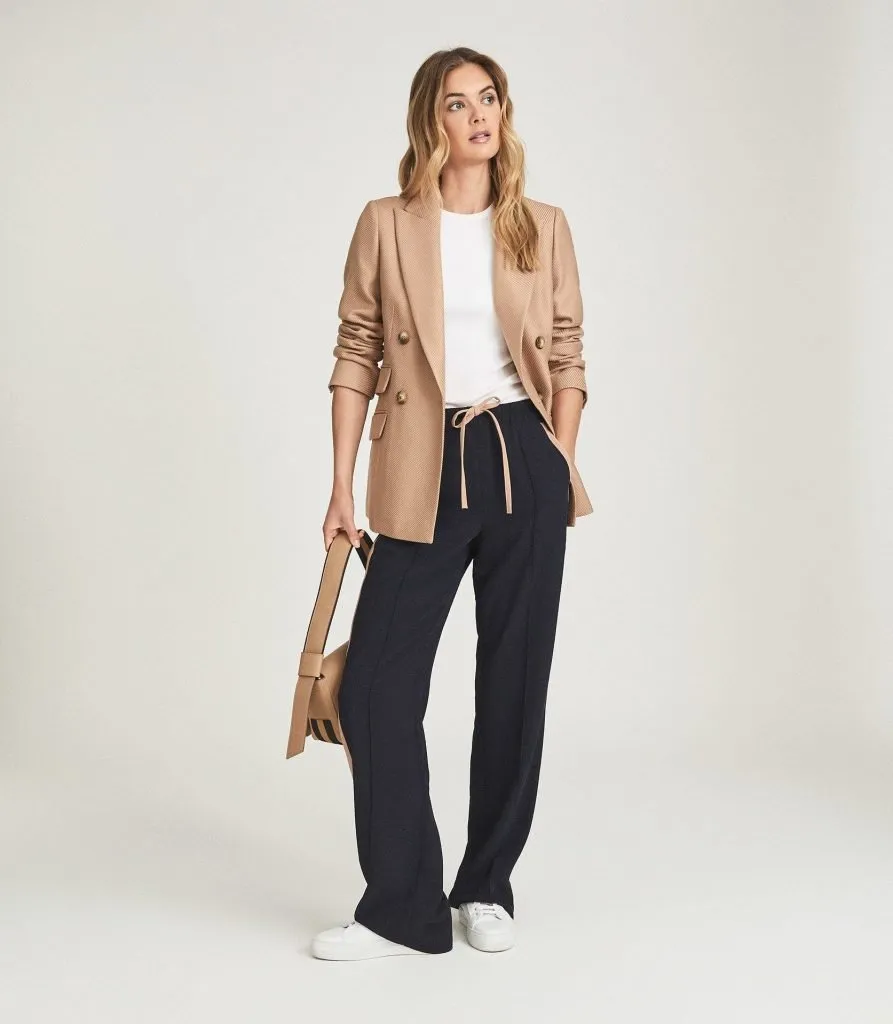
Skip the impulse shopping. The single most effective thing you can do before spending money on work clothes is pull everything out and figure out what you already have.
Most people returning to the office after an extended WFH period make the same mistake: they walk into a store, spend $400, and end up with six new pieces that don’t work with anything they own. Do the audit first. Buy second.
Do a Full Wardrobe Audit Before You Spend Anything
This takes about 45 minutes. It will save you at least $200 in impulse buys and prevent you from duplicating pieces you already own.
Pull every item you used to wear to the office into one place. Try each piece on — not just hold it up. Sit down. Raise your arms. Walk around. Office clothes need to work across a full 8-hour day, not just a 2-minute mirror check in good lighting. Sort each piece into one of five categories:
- Still works: Fits well, no visible wear, appropriate for your current dress code. Keep and set aside for your rotation.
- Needs repair: Missing button, loose hem, needs dry cleaning. Fix it this week or donate it. Don’t let it sit in a maybe pile — it will stay there forever.
- Wrong fit now: Bodies change after extended time at home. A suit that’s off by two sizes isn’t worth a $150 alteration unless it’s genuinely exceptional quality. Donate it.
- Wrong vibe: Dress codes have shifted significantly since 2019. If something feels off, it probably is. Trust that instinct over sunk-cost thinking.
- Done: Pilled, stained, or a silhouette that reads as clearly dated. This pile goes straight to the donate bag.
After sorting, most people find they only need 3–5 new pieces to fill real gaps. Not a whole new wardrobe.
Confirm the actual dress code before you shop
Offices that were business formal in 2019 are often business casual now. If you’re not certain what people are actually wearing, ask a manager directly or look at photos from recent in-person events. Buying a $300 suit for a jeans-and-blazer culture is wasted money. Buying casual pieces for a finance or law office is a different kind of waste. Confirm first, then shop.
Prioritize fit over quantity
One well-fitting blazer beats three ill-fitting ones. If you’re rebuilding after a long gap, spend more on fewer pieces and get them tailored if needed. A blazer that fits cleanly at the shoulders and chest will work harder than one that bunches and pulls — regardless of the price point. Budget for one tailoring visit after your first round of purchases.
The 10 Core Pieces That Cover 90% of Office Situations
This is the wardrobe skeleton that most office environments — from business casual to business professional — actually need. Build from this list before adding anything else. Everything here remixes with everything else.
| Piece | Why It Works | Budget Pick | Mid-Range Pick | Price Range |
|---|---|---|---|---|
| Tailored trousers (neutral) | Pairs with everything; bridges formal and casual | Uniqlo Smart Ankle Pants | Theory Treeca Pull-On Pant | $40–$195 |
| Blazer (navy or charcoal) | Elevates any outfit instantly | Quince Stretch Crepe Blazer | Banana Republic Monogram Blazer | $80–$220 |
| Button-down shirts (2–3) | Versatile across formality levels | Uniqlo Premium Linen Shirt | Everlane The Silky Cotton Shirt | $30–$98 |
| Sheath or midi dress | One-piece dressing — no coordination needed | Amazon The Drop Occasion Dress | M.M. LaFleur Shirley Sheath | $40–$185 |
| Dark wash jeans (if dress code allows) | Bridges casual and smart-casual reliably | Madewell Roadtripper Straight | AG The Prima Mid-Rise Cigarette | $85–$195 |
| Loafers or oxford flats | Professional look that is actually walkable | Sam Edelman Loraine Loafer | Cole Haan ZeroGrand Oxford | $80–$170 |
| Merino knit sweater | Replaces a blazer for smart-casual days | Uniqlo Extra Fine Merino Crewneck | Quince Mongolian Cashmere Crewneck | $30–$100 |
| Structured work bag | Fits laptop and essentials without chaos | Everlane The Day Market Tote | Dagne Dover Large Tote | $65–$195 |
| Black trousers (second pair) | Works as a suit bottom or standalone | H&M Tailored Trousers | J.Crew Cameron Pant | $30–$128 |
| Alternate flat shoe | Rotation prevents wear and foot fatigue | Clarks Clarkdale Arlo | Allbirds Tree Lounger | $60–$115 |
You don’t need all ten at once. If your audit left you with trousers, a blazer, and shirts already covered, fill in footwear and a bag first. Those are the fastest ways to look pulled together without rebuilding from scratch.
The one-in-one-out rule
For every new piece you bring in, retire one old one. This keeps your wardrobe manageable and forces deliberate choices rather than accumulation. A smaller, coherent wardrobe is easier to get dressed from than a large, disorganized one — and it makes gaps obvious when they actually appear.
How to Tell If an Old Work Piece Is Actually Still Wearable
This is where people fool themselves. “It still fits” and “it looks good on me” are not the same thing.
The fit test is the first filter. Put on the piece and sit at a desk. Stand back up. Reach across a table like you’re handing someone a document. If the jacket pulls at the shoulders, the shirt gaps at the buttons, or the trousers create a hard crease under the seat — that’s a fit problem, not a style preference. Tailoring can fix small issues (taking in a waist, shortening a hem), but cannot fix structural sizing mismatches without significant cost. Expect $80–$150 per piece minimum at a tailor for anything beyond minor adjustments.
Fabric condition: what to actually look for
Run your hand across the surface of each piece. Pilling on a wool blazer signals age. A fabric shaver — they run $10–$20 at any drugstore — can de-pill once or twice, but heavy pilling means the garment has reached the end of its useful life. Check under the arms for fading or staining. Check collar and cuff edges on shirts: worn, frayed edges there are the clearest signal that a piece is done, regardless of how well the rest of it holds up.
Lining is a hidden problem in blazers and suit jackets. Pull the jacket open and examine the seams near the armpits and across the back. A split or fraying lining means the jacket is structurally compromised. Repairs run $40–$80 at a tailor and are rarely worth it on anything below a mid-range price point.
Silhouette: is it actually dated?
Lapel width is the easiest tell on blazers. Less than 2 inches reads early-2010s slim-fit. More than 3.5 inches reads 1970s revival. The current standard sits between 2.5 and 3 inches, with a notch lapel in most business contexts. Trouser break matters too — heavy pooling at the ankle feels distinctly early-2000s. Contemporary silhouettes land at a slight break or no break at all, with a straighter leg from hip to hem.
For women’s pieces, the shoulder is the most common dating problem. Strongly padded power-suit shoulders read costume-level dated in most 2026 offices. Natural, lightly structured shoulders — the kind sold at most mid-range retailers today — are what reads contemporary. Skirt and dress length matters equally: anything hitting mid-thigh works better in casual contexts than in most corporate ones.
When to stop second-guessing and donate
If you’re unsure, put it on and take a full-length photo. Look at it the way you’d look at a colleague across a conference table. That distance usually makes the answer obvious. Any piece that makes you think “I hope no one notices X” is already costing you confidence. It is not worth keeping.
Specific Pieces Worth Buying Right Now
If you only buy one thing, make it a well-fitting blazer in navy or charcoal. Nothing else in a work wardrobe does as much work per wear. It converts a shirt-and-trousers combination from running errands to client meeting in seconds. It works over a dress, over dark jeans, over almost anything already in the closet.
For the blazer specifically: the Quince Washable Stretch Crepe Blazer at $80 is the best value on the market right now. Machine-washable, holds structure through a full day, and comes in navy, black, and camel. For something with more presence and longevity, the Banana Republic Monogram Blazer runs $200–$220 — but it frequently hits 40% off and is built to last several years with proper care.
Trousers: Uniqlo first, Theory if budget allows
The Uniqlo Smart Ankle Pants ($40) are the best budget work trouser available. Over 15 colorways, flattering mid-rise, minimal wrinkling in transit, true-to-size fit. That combination is nearly impossible to beat at that price. If you want a step up in drape and all-day comfort, the Theory Treeca Pull-On Pant ($195) uses a ponte crepe that stays crisp through a full day without a waistband digging in after lunch.
Footwear with actual cushioning
WFH feet are not prepared for commute days. The Cole Haan ZeroGrand Oxford ($170) has a foam-cushion outsole inside a leather upper that looks completely traditional — no one can tell it’s not a standard dress shoe. The Sam Edelman Loraine Loafer ($80) is the budget version that holds up through a full work day without destroying your feet. Skip any heel above 2 inches for the first few weeks back. Your feet need to readjust to walking and standing before you add height.
The bag worth buying
The Dagne Dover Large Tote ($195) has a padded laptop sleeve for up to 15 inches, built-in organizational pockets, and neoprene fabric that wipes clean. It looks structured without looking stiff. The Everlane Day Market Tote ($65) works if you prefer a leather option and carry a lighter daily load.
Footwear Is the Fastest Way to Undermine an Otherwise Good Outfit
Worn-down heels, scuffed toe boxes, and stretched-out loafers read as neglect — even on an otherwise sharp outfit. Before your first day back, take your best pair to a cobbler for a heel replacement and a polish. A basic service runs $20–$40 and makes a three-year-old shoe look new. This single step delivers a better return than almost any new purchase you could make.
Building a Weekly Rotation That Removes Decision Fatigue
The goal is to never stand at your closet for more than three minutes in the morning. A planned rotation gets you there — and it takes less setup than it sounds.
How many complete outfits do you actually need?
For a five-day week: four complete outfits minimum. Day five should be a reliable casual Friday fallback — dark jeans, clean shirt, loafers. You don’t need five unique combinations. You need components that remix without looking recycled. A navy blazer worn over grey trousers on Monday can pair with dark jeans and a white shirt on Thursday and read as two genuinely different outfits if the shoes change and the shirt tuck is different.
A working 5-day rotation in practice
- Monday: Charcoal trousers + white button-down + navy blazer + Cole Haan oxfords
- Tuesday: Sheath dress (M.M. LaFleur Shirley in navy or black) + Sam Edelman loafers
- Wednesday: Dark wash jeans + merino crewneck + same navy blazer, different shoes
- Thursday: Black trousers + silk or satin blouse + structured bag for a more polished finish
- Friday: Dark jeans + clean casual shirt + loafers
Five days. Seven garments. No morning decision spiral.
Should you plan outfits in advance?
Yes. Ten minutes on Sunday. Mentally confirm each day’s pairing, or lay the pieces out if that helps you commit. If Wednesday is a presentation, that’s when you pull the blazer-and-trousers combination — not Thursday’s more casual remix. Planning ahead catches problems before they become 7am emergencies: a shirt that needs ironing, shoes that need polishing, a blazer that’s still at the dry cleaner.
The rotation method also reveals what you actually wear versus what you think you wear. After six weeks, the pieces you keep reaching for are worth duplicating in a second color. The ones you skipped three weeks running are candidates for donation — regardless of what you originally paid for them.
A tight, deliberate wardrobe of 15 pieces you trust beats a packed closet of 60 you don’t.

Related Posts


