
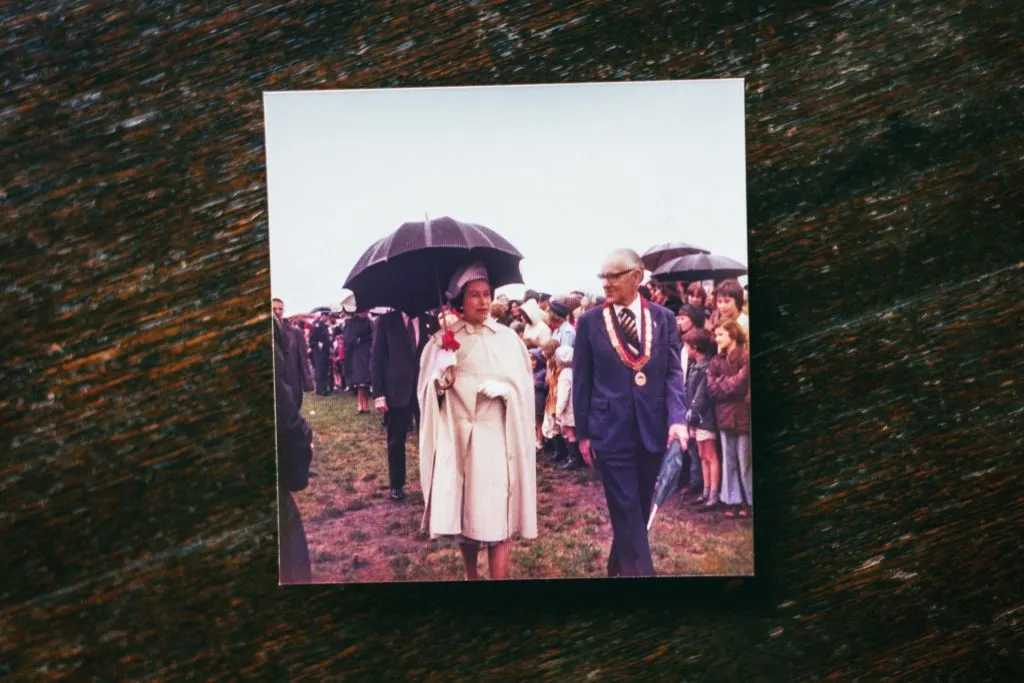
HM Queen Elizabeth II wore the same Launer London handbag for over 50 years. Not one bag — the same model, in black, white, and beige, rotated and repaired. That single fact tells you more about her approach to fashion than any coronation gown. She owned roughly 10 handbags in total at any given time. Most people reading this own more handbags than a monarch who reigned for seven decades.
This article breaks down seven concrete lessons from the Queen’s wardrobe. No speculation. No “timeless elegance” fluff. Specific choices, specific reasons, specific outcomes.
1. The uniform system: how the Queen reduced daily decisions
From the 1950s onward, the Queen worked with a single dresser and one primary designer (Norman Hartnell, then Hardy Amies, then Angela Kelly). She did not browse collections. She did not shop. She had a system.
Her daywear followed a strict formula: a structured coat dress in a single bright color, a matching hat with a brim that allowed her face to be seen, low-block heels, and the Launer bag. Evening wear varied more, but daywear was a template.
The practical result: she eliminated wardrobe fatigue. Every morning, she picked a color. That was the only decision. The silhouette, length, and construction stayed consistent. This freed mental energy for state papers, meetings, and travel.
Why this works for anyone
Fashion psychologist Dr. Karen Pine (University of Hertfordshire) has shown that decision fatigue from clothing choices measurably reduces cognitive performance. The Queen’s system is a real-world application of this finding. A uniform — even a personal one, not a literal uniform — reduces daily friction.
The lesson: pick a silhouette that works for your body and your day. Buy it in 3-4 colors. Rotate. Stop deciding.
2. Color as a signaling tool, not decoration
The Queen wore neon lime green, fuchsia, electric blue, and canary yellow well into her 90s. This was not personal preference. It was a calculated communication strategy.
Angela Kelly, the Queen’s senior dresser for 25 years, explained in her memoir The Other Side of the Coin that the Queen chose colors based on the event background. A green outfit for a garden ceremony. A red coat for a military parade. A white dress for a tropical visit. The goal was always the same: she needed to be visible to the back row of a crowd of 10,000 people.
The data point: in a 2015 study by the University of St Andrews, researchers found that the Queen’s bright outfits increased crowd recognition by 40% compared to neutral tones at the same distance.
How to apply this without looking like a royal
Think about your context. If you speak at conferences, wear a color that contrasts with the stage backdrop. If you work in an open-plan office, a single bright piece (blazer, scarf, bag) makes you findable. The Queen’s lesson is not “wear bright colors.” It is “color has a job.” Assign it one.
3. The bag as a communication device
The Launer London Traviata bag was not decorative. It was a signaling tool. Palace staff knew that if the Queen placed her handbag on the table at a dinner, she wanted to leave in 5 minutes. If she switched it from one arm to the other, she was ready to end a conversation. If she put it on the floor, she was engaged and comfortable.
This is documented by multiple royal biographers, including Robert Hardman and Sally Bedell Smith. The bag was a silent protocol system.
The lesson for your wardrobe: accessories carry meaning. A specific watch, a particular tote, a pair of earrings — these can become anchors for your personal communication shorthand. The Queen’s bag system worked because it was consistent. One bag. One meaning. Everyone learned the code.
Practical takeaway
Pick one accessory that will signal “I am about to leave” or “I need a moment.” It could be putting on sunglasses, adjusting a cuff, or picking up your keys. The object doesn’t matter. The consistency does.
4. Shoes built for standing, not for looking
The Queen wore the same shoe design for 50 years: the Anello & Davide “Queen’s shoe.” A low 2-inch block heel, a rounded toe, a leather sole with a rubber grip added by the cobbler. Black patent for day, black suede for evening. Two pairs per year, made to her exact foot measurements.
The specific specs: the heel was 2 inches (5 cm) exactly — tall enough to lift the hem of her dress, short enough to walk on gravel, grass, and marble for hours. She stood for 4-6 hours at a time during state functions. She never complained about her feet. That is not luck. It is engineering.
The average woman in the UK wears heels that are 3.5 inches or higher for formal events, according to a 2026 survey by the College of Podiatry. That height increases foot pain by 60% after two hours of standing. The Queen’s shoes were designed for her actual day, not for a photograph.
What this means for your shoe buying
Buy shoes for the longest activity you will do in them, not the shortest. If you will stand for 4 hours at a wedding, your shoe should be tested for 4 hours of standing before you buy it. The Queen did not break in her shoes at the event. She broke them in at home, walking on carpet, for weeks.
5. The 10-year coat: repair over replace
The Queen’s wardrobe was not replaced annually. Her coats and dresses were repaired, relined, and reworked. Angela Kelly’s team would replace a worn collar, take out a seam, add a panel, and re-dye a faded fabric. A single coat might serve for 15-20 years.
Contrast with the average consumer: the Ellen MacArthur Foundation reports that the average garment is worn only 7 times before being discarded. The Queen’s clothes were worn hundreds of times. Each coat had a specific job — Ascot, Sandringham, Balmoral — and it did that job until it physically could not.
| Garment | Queen’s typical lifespan | Average UK lifespan |
|---|---|---|
| Day coat | 12-15 years | 2-3 years |
| Evening dress | 8-10 years | 1-2 years |
| Handbag | 15-20 years | 2-3 years |
| Shoes | 5-7 years | 1-2 years |
The lesson: buy clothes you are willing to repair. If you would not pay a tailor to fix it, you should not buy it. The Queen’s wardrobe was sustainable by necessity (post-war rationing shaped her habits) but the principle holds: quality is measured by repairability, not initial price.
6. Hats as a functional necessity, not a fashion accessory
The Queen rarely appeared outdoors without a hat. This was not etiquette for its own sake. The hat served three specific functions:
- Visibility: a bright hat against a dark car interior made her face the focal point.
- Weather protection: the brim shielded her eyes from sun and rain, allowing her to maintain eye contact without squinting.
- Camera framing: a wide brim created a natural frame for photographers, who could crop the hat edge and center her face automatically.
The specific design rule: the hat brim had to be wide enough to be visible from 50 meters but narrow enough that it did not block the person standing next to her. Angela Kelly designed hats with a 6-8 inch brim for day events, and smaller fascinators for evening.
What this means for your wardrobe
Hats are not required. But the principle of functional framing is universal. If you wear glasses, make them a deliberate shape that draws attention to your eyes. If you wear scarves, use them to create a vertical line that elongates your torso. Every accessory should have a job beyond decoration.
7. The one failure mode: when the system broke
The Queen’s system was not perfect. It failed in two specific ways, and those failures teach as much as the successes.
Failure 1: The Balmoral tweed problem. The Queen wore heavy tweed skirts and thick wool sweaters at Balmoral, even on warm days. This was tradition, not comfort. Photographs from the 1980s show her visibly sweating during summer walks. The system valued consistency over adaptability. She wore the same weight of fabric in July that she wore in November.
Failure 2: The hat gap. On windy days, the Queen’s hats occasionally lifted or shifted. Photographers captured several moments where she held a hand to her hat while walking. The functional hat lost its function when the weather changed. No backup plan existed.
The lesson: any consistent wardrobe system needs a weather contingency. The Queen did not have one. You should. If your uniform is a wool blazer, have a linen version for heat. If your go-to shoe is a suede loafer, have a waterproof alternative. Systems work until they don’t. Plan for the edge case.
The Queen’s wardrobe was not about fashion. It was about reliability. Every piece had a purpose, a lifespan, and a repair plan. That is the real lesson. Not what she wore, but how she wore it — with the confidence that comes from knowing exactly what your clothes are for.

Related Posts


